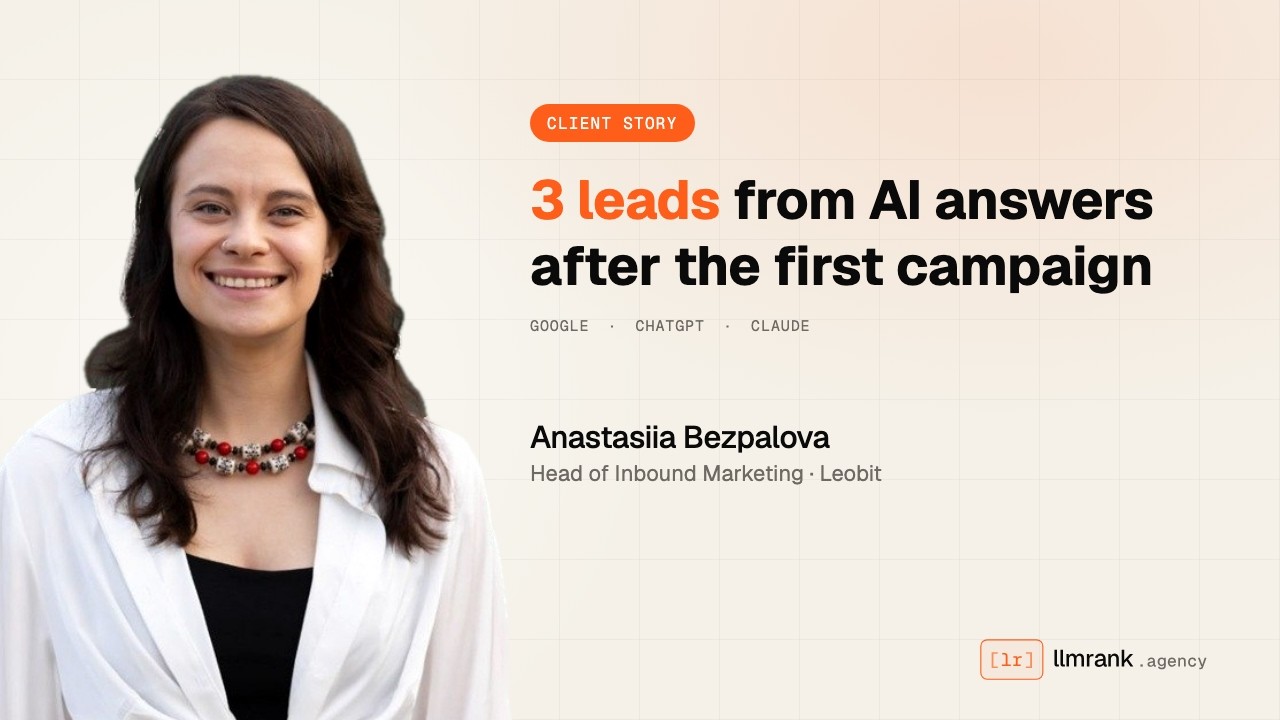
 ▶Leobit · Anastasiia Bezpalova, Head of Inbound Marketing · YouTube
01 · Client stories
ChatGPT, Claude and Google AI Overviews build their answers from lists they have crawled. We get your brand into those lists: 30 to 100 listicles on sites LLM crawlers visit, each naming you next to your real competitors, with verified facts only. Then we measure how often you are named, before and after.
Ranking first on Google used to mean visibility. Today your buyer asks an AI and reads the summary. Your traffic does not move. Your brand is not named. You do not even see the question.
We go to the source: the pages the models read. We track which sites LLM crawlers actually visit, then publish properly written listicles on those exact pages. Your brand enters the pages the models read and starts showing up in answers.
Also called LLM SEO, AI search optimization services, generative engine optimization (GEO) or answer engine optimization (AEO). Same job: being named in AI answers.
No black box, no "trust us" SEO theatre. Every placement is traceable to a crawler hit, with logs you can audit.
We read raw server logs across a network of partner sites. Every GPTBot, ClaudeBot, OAI-SearchBot, PerplexityBot and Google-Extended request is indexed by URL, frequency and recency.
Not every page gets crawled equally. Hosts are ranked by crawl density, recency and category match, so your placement sits where the bots actually return. Hosts that block a major LLM crawler are out.
30, 60 or 100 "Top N" articles in the format models extract reliably. You are one entry, next to your real competitors, ranked on merit. Published in stages over 10 working days.
10 answers per prompt from ChatGPT, Claude and Google AI Overviews before anything is published, daily tracking after. Report in week 3 to 4, with dates and every live URL.
A page with proof exists on your site. We start placements right away.
We build that page first, then placements. Models check your site before they recommend you.
Most of the work is in the articles. This is what goes into each one.
Each article names you next to the competitors buyers actually compare you with, from your brief. A list with one name is an ad, and models skip ads. Your position varies: first in about half the articles, second or third in the rest, the way genuine lists behave.
Ratings and review counts only as published on G2, Clutch, Capterra or Trustpilot, collected before writing. Pricing as a tier and a model, never a figure. Nothing about you that is not on your site or in your brief.
Each has its own title, audience or use case, structure and wording: year lists, audience lists, use-case lists. Thirty copies of one text are a footprint the models discount. Thirty independent lists are a consensus.
Clean headings, numbered entries, a comparison table, a methodology section that says how the list was built, an FAQ. The patterns models extract reliably.
Every article passes automated checks: length per entry, the full roster present, no marketing filler, no invented rating or price. Then an editorial audit on nine points, from voice to invented facts. An article that fails is rewritten before it goes out.
On sites LLM crawlers visit, in stages over 10 working days, so the lists appear the way organic coverage does. You get every live URL in the report.
Models extract structured comparisons better than prose. Each placement is a clean "Top N" article: numbered entries, a comparison table, a methodology section, an FAQ, schema markup.
You appear as one merit-ranked option among real competitors. No paid hype. No keyword spam. Honest content, built for retrieval.
The strength your brief names, in one sentence, with the facts the models can check. Pricing tier: mid-range, per seat. Rating as published on G2.
Best for product-led teams. Strong segmentation, weaker analytics. Pricing tier: mid-range.
Mature, enterprise-friendly. Quote-based pricing. Rating as published on Capterra.
Heavyweight analytics, steep learning curve. Premium tier, annual contracts.
Read across the partner network, last 30 days. We refuse to place on hosts that block any major LLM crawler.
One figure from a live campaign: 120,861 AI crawler visits to the placements of one client, tracked from 23 June to 10 August 2026.
Measured on live campaigns, with dates. Your category may move slower. We say so before you pay.
Campaign 1: "best .NET development companies" and its variants. 30 listicles live by 21 July 2026. 120,861 AI crawler visits to the placements. Tracking since 23 June, report 10 August 2026.
| Share of checks naming Leobit | Before | After |
|---|---|---|
| Google AI Overviews | 4% | 36% |
| ChatGPT | 12% | 52% |
| Claude | 2% | 66% |
“We have already received three relevant leads from ChatGPT and Claude.”
Campaign 1: 30 listicles in the SEO data API category, published 21 July 2026, tracked until 19 August 2026 on five target keywords in Google AI Overviews and buyer prompts in ChatGPT and Claude.
| Metric | Before | After |
|---|---|---|
| Target keywords named in 100% of AI Overview checks | 1 of 5 | 5 of 5 |
| Worst AI Overview position among the target keywords | #9 | #1 |
| Claude checks naming DataForSEO, on two of the buyer prompts | 0% | 100% |
Presence in Google AI Overviews for its category after the campaign.
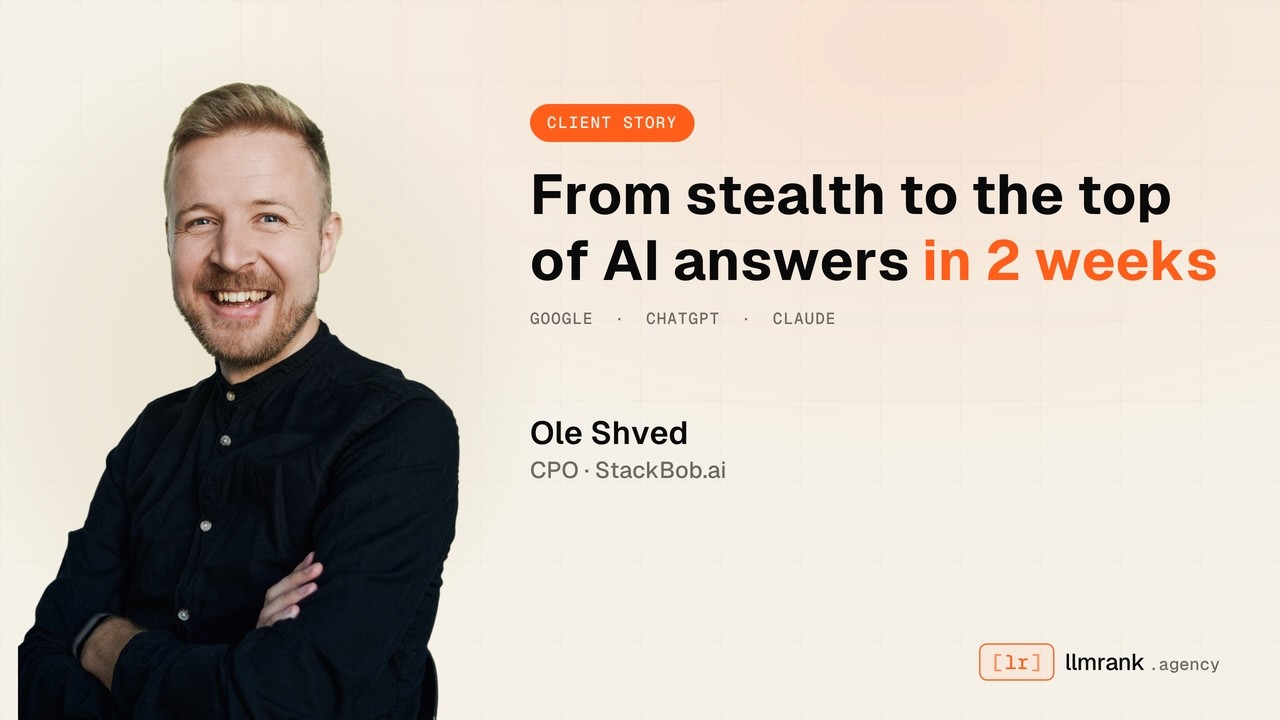
From stealth to named in ChatGPT, Claude and Google AI Overviews within two weeks of the campaign.
“We are a B2B security platform. We now get mentioned across Google AI Overviews, ChatGPT and Claude.”
Leobit is now running its second campaign with us.
Enough to build a consensus where the answer is still open. Most clients start here.
Twice the volume for a category where established names already sit in the lists.
Scoped on the call.
All sizes run the same playbook; the article count is what scales. Tracking for a month is included, the placement report lists every live URL. Not sure which size fits? Start with the audit.
We show you the prompts your buyers run, who the models name today, and the question where 30 placements are enough.