Software development and IT outsourcing · US and EU buyers

LLM SEO for software development companies

Buyers ask ChatGPT, Claude and Google AI Overviews for a development partner and get a list of five names. We get your company into the lists those answers come from. Then we measure how often you are named, before and after.

3 surfaces tracked: ChatGPT, Claude, AI Overviews
Brands we work with
DataForSEOLeobitFortes VisionStripoDataImpulseStackBob
01 · Prompts

What your buyers ask AI

buyer asks

"best .net development companies"

returns 3 to 7 names
buyer asks

"top fintech software development companies for a mid-size bank"

returns 3 to 7 names
buyer asks

"we need a logistics app built, which outsourcing company would you recommend"

returns 3 to 7 names

Each prompt returns three to seven names. If you are not on the list, the buyer never visits your site. Buyers use four kinds of prompts: problem-aware ("we need a logistics app built"), vendor-discovery ("best .NET development companies"), comparison ("X vs Y") and trust ("is X reliable"). The campaign targets vendor-discovery and comparison prompts; your own site answers the other two.

02 · How the answer is built

How an AI assistant builds the shortlist

Not a theory. The searches below are what ChatGPT and Claude actually ran when we asked them for a development partner.

01 · Prompt

The question becomes several searches

The assistant does not look up your name. It splits "best .NET development companies" into searches: the category and its synonyms, the stack, the vertical, "2026", "case studies". In our tests ChatGPT ran 3 to 7 searches per answer, Claude 2. Google calls this query fan-out.

02 · Sources

The searches return lists

Directory pages, media roundups, review sites and vendors' own lists. ChatGPT fetches them live with its crawlers; Google AI Overviews read Google's index. If you are in none of these pages, you are out before the model has formed an opinion.

03 · Consensus

Names that repeat become the shortlist

The model keeps the names that several sources agree on and drops the rest. One list is an opinion. Five lists with the same five names is a consensus, and the "best for" lines are copied from those pages.

04 · Check

Your site confirms or kills the claim

Before recommending, the model checks the candidate's own site and profiles: does the service page say the same, do Clutch and GoodFirms agree, are OAI-SearchBot, ClaudeBot and Googlebot allowed in robots.txt. A mismatch or a blocked crawler, and the name is dropped.

Our work is step 2: we put you into the lists those searches return. The lift in visibility shows one to two weeks after the campaign.

03 · The gap

Why you are not in the answer

Classic SEO meant ranking a page on Google. LLM SEO means being named when a buyer asks an AI for a development partner. It is also called generative engine optimization (GEO), answer engine optimization (AEO) or AI search optimization. Same job, different source: the answer is built from lists, not from your page.

AI answers about service companies come from lists: directory pages, media roundups and vendors' own lists. A Clutch profile makes you a source. It does not make you a recommendation.

A recommendation needs several independent lists that agree on you. Five lists with the same five names is what the model repeats.

Your own blog helps little. Third-party lists get most citations, self-promotional ones about a tenth.

Peec AI, analysis of 232,000 citations, December 2025 to February 2026.

We add the missing lists: on sites the crawlers read, naming you next to the competitors you lose to today.

04 · Process

How it works

We start with a narrow question. "Best software development company" is not for sale here.

01 · Question

Pick the question

Your stack, vertical and geography. "Ruby on Rails development companies in the Netherlands", not "best software development company".

02 · Baseline

Measure before

10 answers per prompt from ChatGPT, Claude and Google AI Overviews before anything is published.

03 · Placements

Publish

30 listicles, published in stages over 10 working days. Each names you next to real competitors, on sites LLM crawlers visit. We pick the sites by crawler data, not domain rating.

04 · Report

Report

Daily tracking. Report in week 3 to 4: mention share per surface, before and after, with dates.

05 · Results

Results and case studies

Measured on live campaigns, with dates. Your category may move slower. We say so before you pay.

Fitness app development company · name under NDA
0% → 60%

Presence in Google AI Overviews for its category after the campaign.

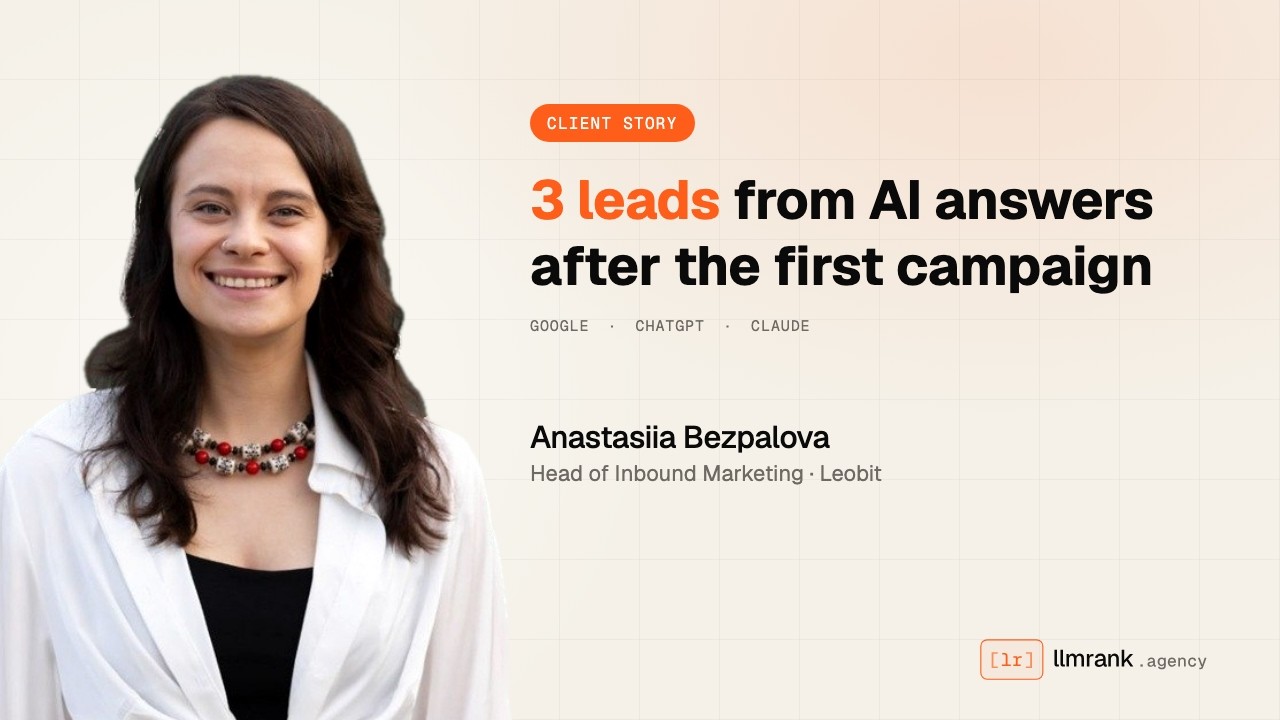
Leobit is now running its second campaign with us.

06 · Fit

When this is not for you

✕
The company has no footprint online yet.Reviews, a working site and other traces of the business must already exist. Models repeat what they can verify. We do not launch brands from zero.
✕
You want the head term in two weeks.We start with narrow, winnable terms and show results after the first campaign. The main category is rarely won in a month.
✕
You want to pay after you get leads.We are paid for visibility, which we measure and report. In about 8 of 10 campaigns so far, visibility improved within two weeks of publication, and leads usually follow. We do not bill per lead.
07 · Prices

Prices

Narrow question

30 placements

$3,500
one keyword: stack, vertical or geography

Enough to build a consensus where few names compete. Most dev shops start here.

Contested category

60 placements

$7,000
one keyword, two or three known competitors

Twice the volume for a category where established vendors already sit in the lists.

Custom

100 and more

Custom
several keywords or a crowded category

Scoped on the call.

Tracking for a month is included. The placement report lists every live URL.

08 · FAQ

Questions

We are on Clutch. Is that not enough? +
Clutch is a source. Models cite it, but they recommend the names that several independent lists agree on. We build that agreement.
Our main keyword is too competitive. +
That is why we do not start there. Stack, vertical and geography narrow the question to one your competitors have not claimed.
Can the keyword include our city or state? +
Yes. Geography is the strongest narrower for service companies. We measure from a US location by default.
Do you name our competitors? +
Yes, in every article. A list without competitors is an ad, and models skip ads.
Do you do Reddit or forum seeding? +
No. Reddit removes it, and it is not where buyer answers come from.
How do I get my software development company recommended by ChatGPT? +
Be named in several independent lists for one narrow question, on sites ChatGPT crawls, and have a service page on your site that confirms it. That is the campaign described above. The same applies to IT services and IT outsourcing companies.
What results can we expect, and how are they measured? +
Being named in the answers to your buyers' prompts. We measure it as how often you are named per prompt on ChatGPT, Claude and Google AI Overviews, before and after the campaign, with dates. On the campaigns we have run, the lift showed one to two weeks after publication; Leobit got leads from ChatGPT and Claude after that. Referral traffic from AI assistants and branded searches usually grow later, and we do not promise a number for them.
Is this GEO or AEO? +
Same thing under different names: generative engine optimization (GEO), answer engine optimization (AEO), AI search optimization, LLM SEO. All of them mean being named in AI answers. We say LLM SEO because the answers come from large language models.
What should be on our site before the campaign? +
The models look for five things: what you do, who you are best for, why you are credible, which independent sources confirm it, and whether you are the safer pick. A service page for the chosen direction with plain facts answers the first three: what you build, for whom, where, since when, named clients. Clutch and GoodFirms profiles that say the same thing answer the fourth. Crawlers allowed in robots.txt: OAI-SearchBot, ClaudeBot, Googlebot. We check this on the call and tell you what is missing.
How much does it cost? +
30 placements $3,500, 60 placements $7,000, 100 and more: custom. Tracking for a month is included.
09 · Call

Book a 20-minute call

We show you the prompts your buyers run, who the models name today, and the narrow question where 30 placements are enough. Free, whether you buy or not.