B2B SaaS · $1M to $100M ARR

LLM Optimization for B2B SaaS

Buyers ask ChatGPT, Claude and Google AI Overviews which software to buy and get a shortlist. The model takes it from listicles, not from your site or your G2 page. We get your product into those listicles, in the questions where the answer is still open, and measure your mention share before and after.

3 surfaces tracked: ChatGPT, Claude, AI Overviews
Brands we work with
DataForSEOLeobitFortes VisionStripoDataImpulseStackBob
01 · Prompts

What your buyers ask AI

buyer asks

"best identity governance software for a 300-person company"

use case · open
buyer asks

"alternatives to [the incumbent] for a small team"

alternatives · open
buyer asks

"which project management tool fits a remote dev team"

requirement · open

"Best CRM" belongs to aggregators and incumbents. The narrow questions above are where a product with a real strength gets named within weeks. Buyers use four kinds of prompts: problem ("how do we manage access for 300 people"), discovery ("best identity governance software"), comparison ("X vs Y", "X alternatives") and trust ("is X SOC 2 compliant"). The campaign targets discovery and comparison prompts; your own pages answer the other two.

02 · How the answer is built

How an AI assistant builds the shortlist

Not a theory. The searches below are what ChatGPT and Claude actually ran when we asked them which software to buy.

01 · Prompt

The question becomes several searches

The assistant does not look up your name. It splits "best identity governance software for a 300-person company" into searches: the category and its synonyms, the use case, "alternatives", "pricing", "reviews", "2026". In our tests ChatGPT ran 3 to 7 searches per answer, Claude 2. Google calls this query fan-out.

02 · Sources

The searches return lists and review pages

"Best X software" roundups, G2 and Capterra category pages, alternatives pages, vendors' comparison pages. ChatGPT fetches them live with its crawlers; Google AI Overviews read Google's index. If you are in none of these pages, you are out before the model has formed an opinion.

03 · Consensus

Names that repeat become the shortlist

The model keeps the names that several sources agree on and drops the rest. Ratings and "best for" lines are copied from those pages. One list is an opinion. Five lists with the same five names is a consensus.

04 · Check

Your product pages confirm or kill the claim

Before recommending, the model checks your site: the use-case page, pricing tier, integrations, compliance, and whether G2 and Capterra say the same. Invented numbers, a mismatch or a blocked crawler, and the name is dropped.

Our work is step 2: we put you into the lists those searches return. The lift in visibility shows one to two weeks after the campaign.

03 · The gap

Why you are not in the answer

Classic SEO meant ranking your pages on Google. LLM optimization means being named when a buyer asks an AI which software to buy. It is also called LLM SEO, generative engine optimization (GEO), answer engine optimization (AEO) or AI search optimization. Same job, different source: the answer is built from lists, not from your page.

AI answers about software come from "best X software" lists with ratings and comparison tables. The head questions belong to aggregators and incumbents. The open ones are narrow: a use case, an alternative to a named incumbent, a compliance or size requirement.

Your own pages and your G2 profile count for little in the answer itself. Self-promotional lists get about a tenth of citations, third-party lists the rest.

Peec AI, analysis of 232,000 citations, December 2025 to February 2026.

Models also drop what they cannot verify. An article that invents a price or a rating for your product gets discounted. We use ratings only as published on G2 or Capterra and describe pricing as a tier, never as a number you did not publish.

We add the missing lists: on sites the crawlers read, naming you in the open questions next to the competitors buyers already compare you with.

04 · Process

How it works

Geography rarely narrows a software question. Use case, alternatives and requirements do.

01 · Question

Pick the question

"Best [category] for [use case]", "[incumbent] alternatives for [segment]", "[category] with SOC 2". Not "best CRM".

02 · Baseline

Measure before

10 answers per prompt from ChatGPT, Claude and Google AI Overviews before anything is published.

03 · Placements

Publish

30 listicles, published in stages over 10 working days. Each names you next to real competitors, with ratings as published and pricing as a tier, on sites LLM crawlers visit.

04 · Report

Report

Daily tracking. Report in week 3 to 4: mention share per surface, before and after, with dates.

You have a page for this use case

A use-case page with proof already exists on your site. We start placements right away.

You do not

We build that page first, then placements. Models check your site before they recommend you.

05 · Results

Results and case studies

Measured on live campaigns, with dates. Your category may move slower. We say so before you pay.

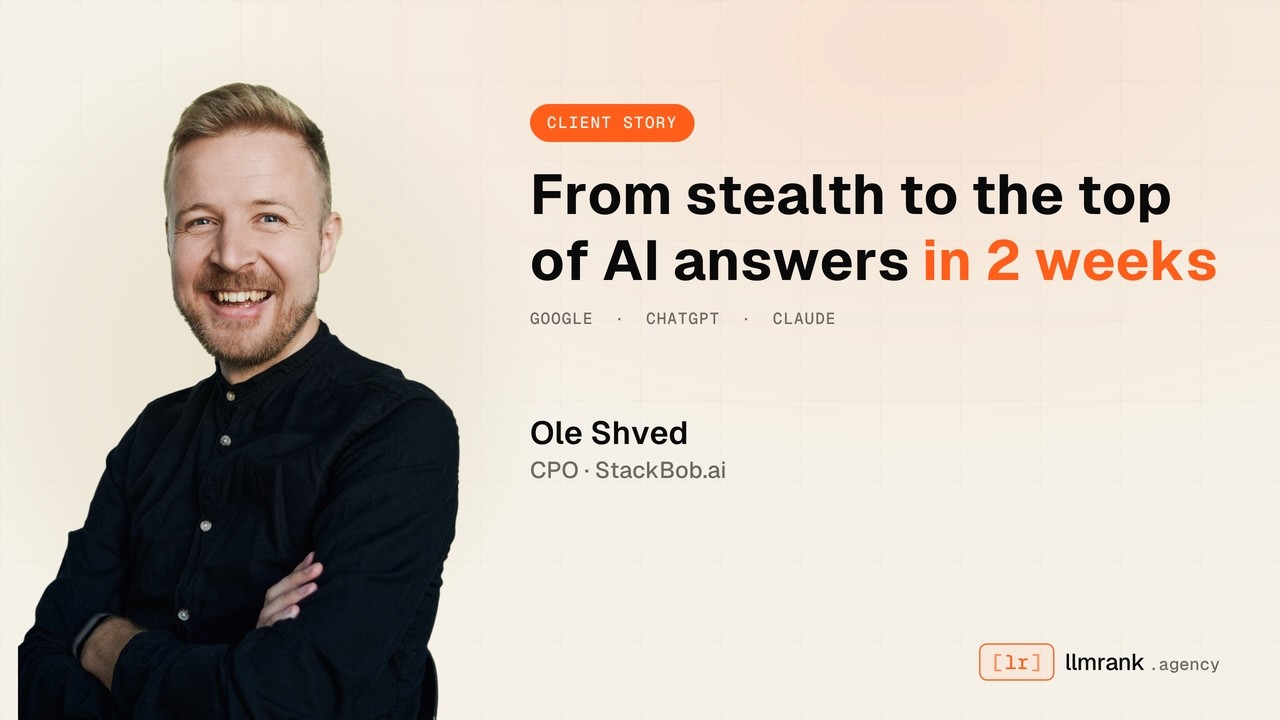
Ole Shved, CPO at StackBob, on camera▶StackBob · Ole Shved, CPO · 1:52 · YouTube
StackBob · identity governance SaaS · Detroit
2 weeks

From stealth to named in ChatGPT, Claude and Google AI Overviews within two weeks of the campaign.

“We are a B2B security platform. We now get mentioned across Google AI Overviews, ChatGPT and Claude.”

Ole Shved, CPO, StackBob
06 · Fit

When this is not for you

✕
The product has no footprint online yet.Reviews, a working site and other traces of the business must already exist. Models repeat what they can verify. We do not launch brands from zero.
✕
You want the head term in two weeks.We start with narrow, winnable questions and show results after the first campaign. The main category is rarely won in a month.
✕
Your product has no real strength.The lists name real competitors and rank on merit. We cannot write you into a position you do not hold.
✕
You want to pay after you get leads.We are paid for visibility, which we measure and report. In about 8 of 10 campaigns so far, visibility improved within two weeks of publication, and leads usually follow. We do not bill per lead.
07 · Prices

Prices

Open question

30 placements

$3,500
one keyword: use case or alternative

Enough to build a consensus where the answer is still open. Most SaaS start here.

Contested category

60 placements

$7,000
one keyword, two or three known competitors

Twice the volume for a category where established vendors already sit in the lists.

Custom

100 and more

Custom
several keywords or a crowded category

Scoped on the call.

Tracking for a month is included. The placement report lists every live URL.

08 · FAQ

Questions

We have hundreds of G2 reviews. Is that not enough? +
G2 makes you citable. The answer still comes from lists, and the lists have to agree on you.
Will you publish our pricing? +
No. Articles describe your pricing tier and model, never a figure you have not published.
Can you make the AI stop recommending a competitor? +
No. We add you next to them, in the same lists, on merit.
Where do the facts about our features come from? +
From your site and from what you confirm in the brief. Nothing else goes into an article.
How fast? +
Placements go out in stages over 10 working days. The first measurable change came one to two weeks after the campaign on the campaigns we have run.
Is this the same as a SaaS SEO agency? +
No. A SaaS SEO agency ranks your pages on Google. We get your product named in AI answers, which are built from third-party lists. Many companies run both.
Is this GEO or AEO? +
Same thing under different names: generative engine optimization (GEO), answer engine optimization (AEO), AI search optimization, LLM SEO. All of them mean being named in AI answers. We say LLM SEO because the answers come from large language models.
Which review platforms matter for AI answers? +
G2 and Capterra. Their ratings are what the lists quote, so we use them only as published. If you have no reviews yet, the lists still name you, without a rating, and reviews become the next step.
How much does it cost? +
30 placements $3,500, 60 placements $7,000, 100 and more: custom. Tracking for a month is included.
09 · Call

Book a 20-minute call

We show you your category prompts, who the models name today, and the open question where 30 placements are enough. Free, whether you buy or not.